
Le commerce de détail de luxe s'est toujours articulé autour d'un service exceptionnel, de l'émotion et de l'exclusivité. Les clients d'aujourd'hui s'attendent à retrouver cette même expérience haut de gamme dans les boutiques, sur les sites web et les applications mobiles. Offrir un parcours premium et cohérent sur tous les canaux n'est plus une option — c'est un impératif stratégique dans le commerce de luxe moderne.
Points clés à retenir
Pourquoi une stratégie omnicanale unifiée est essentielle dans le luxe. Les consommateurs de luxe d'aujourd'hui naviguent de manière fluide entre Instagram, les applications mobiles et les boutiques phares — et s'attendent à retrouver la même expérience haut de gamme partout.
La cohérence est la pierre angulaire du luxe. Dans le commerce de luxe, la cohérence de la marque entre le online, le offline et le mobile est essentielle.
La personnalisation : Le cœur de l'expérience de luxe. Ce qui définit une véritable expérience client de luxe, c'est la personnalisation — faire en sorte que chaque client se sente connu et valorisé.
Alimenter le luxe omnicanal grâce au commerce unifié. Une expérience omnicanale de luxe cohérente repose sur une solide infrastructure de commerce unifié.
Le mobile : Le nouveau flagship du luxe. Dans le commerce de luxe actuel, le mobile n'est plus un canal secondaire — c'est la boutique phare dans la poche de votre client.
Pourquoi une stratégie omnicanale unifiée est essentielle dans le luxe
Les consommateurs de luxe d'aujourd'hui naviguent de manière fluide entre Instagram, les applications mobiles et les boutiques phares — et s'attendent à retrouver la même expérience haut de gamme partout. En fait, les acheteurs omnicanaux dépensent près de deux fois plus que les clients monocanaux.
Alors que les ventes en ligne dépassent désormais 18 % des revenus mondiaux du luxe et devraient atteindre 28 % d'ici 2030, les points de contact mobiles et numériques ne sont plus facultatifs — ils sont essentiels.
Les détaillants de luxe doivent adopter une stratégie agnostique vis-à-vis des canaux, qui allie héritage et technologie. Que les clients naviguent tard dans la nuit ou franchissent la porte d'une boutique, l'expérience doit être constamment premium, personnelle et fluide.
La cohérence est la pierre angulaire du luxe
Dans le commerce de luxe, la cohérence de la marque entre le online, le offline et le mobile est essentielle. Chaque point de contact — de la boutique à l'application — doit refléter le même niveau d'élégance, d'attention et d'exclusivité.
Votre site web et votre application mobile doivent correspondre à l'esthétique et au storytelling de vos boutiques physiques, avec un design épuré, des photographies éditoriales et une navigation intuitive. Les prix, les détails des produits et la disponibilité doivent s'aligner sur toutes les plateformes pour instaurer la confiance.
Ne négligez pas l'expérience post-achat : les commandes en ligne doivent être livrées dans des emballages haut de gamme, accompagnées de mots écrits à la main et d'une livraison gants blancs — reflétant ainsi l'expérience en boutique.
Chaque interaction, qu'il s'agisse d'une notification mobile, d'un chat en ligne ou d'une visite en boutique, doit être vécue comme le prolongement naturel du parcours de la marque. Cette expérience unifiée est ce qui distingue le luxe moderne.
La personnalisation : Le cœur de l'expérience de luxe
Ce qui définit une véritable expérience client de luxe, c'est la personnalisation — faire en sorte que chaque client se sente connu et valorisé. En boutique, cela peut se traduire par un conseiller de vente qui se souvient d'un achat antérieur. En ligne et sur mobile, il s'agit de reproduire cette même attention grâce au clienteling numérique.
Les marques de luxe proposent désormais des consultations de style en direct, des rendez-vous de shopping par vidéo et un support de chat par des experts afin d'offrir un service de conciergerie virtuel. Ces interactions numériques menées par des humains rendent l'expérience tout aussi exclusive qu'un passage en boutique.
En coulisses, les profils clients unifiés alimentés par des plateformes de CRM et de clienteling assistées par l'IA sont essentiels. En intégrant les données du e-commerce, des boutiques et des applications, les marques peuvent anticiper les besoins des clients et personnaliser chaque point de contact — des suggestions de produits sur mesure aux alertes VIP.
Le résultat ? Un parcours fluide et haut de gamme sur tous les canaux qui renforce la fidélité et augmente les dépenses.
Alimenter le luxe omnicanal grâce au commerce unifié
Une expérience omnicanale de luxe cohérente repose sur une solide infrastructure de commerce unifié.
Cela signifie des systèmes entièrement intégrés pour les stocks, les commandes, les paiements et l'exécution — afin que les clients puissent passer sans effort de l'univers en ligne à l'univers hors ligne et mobile.
Des fonctionnalités clés telles que l'achat en ligne avec retrait en boutique (BOPIS) et l'achat en ligne avec retour en boutique (BORIS) sont désormais indispensables. Les acheteurs doivent pouvoir naviguer en ligne, essayer en boutique et retourner leurs articles en personne — chaque point de contact offrant le même niveau de service élevé.
Le commerce unifié prend également en charge un service après-vente personnalisé, des réparations aux échanges, et permet une visibilité en temps réel des stocks de la boutique en ligne. Lorsqu'ils sont bien exécutés, ces services sans friction augmentent la satisfaction et favorisent la fidélisation.
Enfin, les clients du luxe s'attendent à des options de paiement rapides, sécurisées et cohérentes sur tous les canaux — qu'ils utilisent des portefeuilles mobiles, des tablettes POS ou un paiement via l'application. Lorsque les opérations et la technologie sont alignées, les marques peuvent offrir rapidité et commodité sans compromettre l'exclusivité.
Le mobile : Le nouveau flagship du luxe
Dans le commerce de luxe actuel, le mobile n'est plus un canal secondaire — c'est la boutique phare dans la poche de votre client. Pour de nombreux acheteurs, c'est le premier et le plus fréquent point de contact avec la marque, ce qui rend indispensable une expérience mobile de premier ordre.
Cela va bien au-delà du design adaptatif (responsive). Une véritable application mobile de luxe doit proposer un storytelling riche et des fonctionnalités fluides — lookbooks, essais en réalité augmentée, lancements exclusifs et contenus des coulisses. La navigation doit être intuitive, rapide et visuellement en phase avec l'esthétique de la marque afin de garantir un parcours utilisateur fluide et élégant.
Le clienteling mobile est également un facteur de différenciation majeur. Grâce aux notifications de l'application ou aux plateformes de messagerie, les marques peuvent engager une communication personnalisée en temps réel qui s'apparente davantage à un service de conciergerie qu'à du marketing. Chaque interaction doit être réfléchie, respectueuse et à forte valeur ajoutée.
En résumé, traitez le mobile comme une boutique de luxe ouverte 24h/24 et 7j/7 — entièrement intégrée à votre écosystème en boutique et en ligne, animée par des conseillers numériques et conçue pour offrir des expériences sur mesure et haut de gamme à grande échelle.
Donner aux conseillers de vente les moyens d'offrir une expérience de luxe cohérente
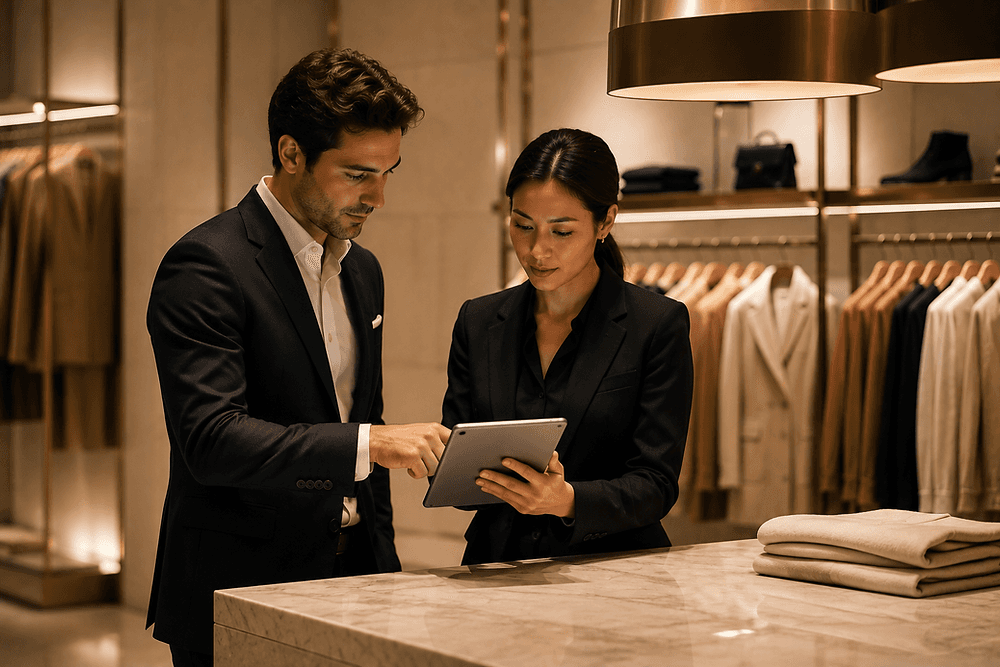
Une expérience de luxe fluide sur tous les canaux commence par vos équipes. Les conseillers de vente et les équipes du service client doivent être formés et équipés pour offrir un service attentionné tant en boutique que par voie numérique. Aujourd'hui, les équipes les plus performantes utilisent des applications de clienteling pour accéder aux profils des clients, à leurs listes d'envies et à leur historique d'achats — ce qui leur permet de personnaliser chaque interaction, même pour les clients qui visitent la boutique pour la première fois.
Les conseillers doivent être à l'aise avec les outils numériques, comprendre les services omnicanaux comme le BOPIS et le BORIS, et accompagner les clients sur toutes les plateformes sans friction. La formation et des processus clairs garantissent qu'aucun client ne s'entende jamais dire : « Je ne peux pas vous aider pour cela. »
Pour encourager une véritable collaboration intercanale, les leaders de la vente au détail de luxe alignent les structures de rémunération variable — en reconnaissant les contributions en ligne et sur application du personnel des boutiques afin d'éliminer la concurrence interne.
Des équipes responsabilisées ont également la liberté de surprendre et de ravir les clients, créant ainsi des moments mémorables qui fidélisent. Lorsque les conseillers sont responsabilisés et motivés, ils apportent le même niveau de soin, que le client discute en ligne ou entre dans une boutique.
En fin de compte, votre personnel est le pilier d'une expérience de luxe agnostique vis-à-vis des canaux. Investissez dans leurs compétences et leurs outils, et ils feront de chaque point de contact le reflet de l'excellence de votre marque.
Stratégies pratiques pour une expérience de luxe unifiée
Pour traduire ces enseignements en actions concrètes, voici les stratégies clés que les détaillants de luxe et leurs conseillers peuvent mettre en œuvre pour offrir une expérience haut de gamme et cohérente partout :
Unifier l'identité de votre marque : Garantissez la cohérence visuelle, de ton et de storytelling entre la boutique, le web et le mobile. Les canaux en ligne doivent susciter la même émotion que vos boutiques, du design élégant à l'emballage premium.
Personnaliser sur tous les canaux : Utilisez une base de données clients unifiée pour personnaliser les expériences. Si un client a sauvegardé des articles en ligne, les conseillers doivent être prêts à l'aider en boutique. Des outils de clienteling tels que le chat en direct et les appels vidéo apportent cette touche personnalisée dans le monde numérique.
Investir dans le commerce unifié : Éliminez les silos entre le online et le offline en intégrant les stocks, les commandes et l'exécution. Proposez le BOPIS, l'extension de gamme en boutique (endless aisle) et des retours fluides pour offrir flexibilité et commodité.
Prioriser le mobile : Traitez le mobile comme une boutique phare dans la poche de votre client. Offrez une visibilité en temps réel sur les stocks des boutiques, un processus de paiement fluide et un support client intégré à l'application. Veillez à ce que les communications restent personnalisées et de grande valeur.
Responsabiliser les équipes en boutique : Formez les conseillers pour qu'ils accompagnent les clients sur tous les canaux. Équipez-les d'outils pour accéder aux informations clients et faciliter le service omnicanal. Reconnaissez et récompensez la collaboration intercanale.
Maintenir un service haut de gamme grâce à la technologie : Laissez l'IA gérer les tâches répétitives, mais préservez l'interaction humaine pour le stylisme, le conseil et la résolution de problèmes. Équilibrez efficacité et empathie.
En appliquant ces stratégies, les détaillants de luxe peuvent bâtir un écosystème connecté où chaque canal renforce le prestige de la marque et où chaque interaction semble sur mesure — qu'elle ait lieu en boutique, en ligne ou sur l'écran d'un smartphone.
Lectures complémentaires de BSPK
Pour en savoir plus sur ce sujet, consultez Qu'est-ce que l'expérience client dans le luxe ?.
Un guide BSPK associé explore Au cœur de la boutique de luxe : à quoi s'attendre lors des rendez-vous, du stylisme et de l'expérience en boutique.
Pour une perspective complémentaire, lisez Le commerce de la relation client vers la boutique dans le luxe : jeter un pont entre la découverte en ligne et l'expérience en boutique.
Les équipes de vente peuvent également consulter Ce qui distingue la vente au détail de produits de beauté de luxe : expérience en boutique, nouveaux formats et soutien au lancement de marque.
Pour plus de contexte pratique, explorez Meilleures pratiques en matière d'expérience client dans le commerce de détail.
Comment BSPK peut vous aider
BSPK aide à connecter la connaissance client et l'activité des conseillers avec l'ensemble des technologies de vente au détail, afin que le contexte client circule de manière plus cohérente entre les canaux et les équipes. Pour les stratégies de vente unifiées, cette couche relationnelle permet de maintenir les données opérationnelles connectées aux personnes qui servent le client.
Foire aux questions
Pourquoi une stratégie omnicanale unifiée est-elle essentielle dans le luxe ?
Les consommateurs de luxe d'aujourd'hui naviguent de manière fluide entre Instagram, les applications mobiles et les boutiques phares — et s'attendent à retrouver la même expérience haut de gamme partout. En fait, les acheteurs omnicanaux dépensent près de deux fois plus que les clients monocanaux.
Que doivent savoir les détaillants sur le fait que la cohérence est la pierre angulaire du luxe ?
Dans le commerce de luxe, la cohérence de la marque entre le online, le offline et le mobile est essentielle. Chaque point de contact — de la boutique à l'application — doit refléter le même niveau d'élégance, d'attention et d'exclusivité.
Que doivent savoir les détaillants sur la personnalisation comme cœur de l'expérience de luxe ?
Ce qui définit une véritable expérience client de luxe, c'est la personnalisation — faire en sorte que chaque client se sente connu et valorisé. En boutique, cela peut se traduire par un conseiller de vente se souvenant d'un achat passé.
Que doivent savoir les détaillants sur l'alimentation du luxe omnicanal grâce au commerce unifié ?
Une expérience omnicanale de luxe cohérente repose sur une solide infrastructure de commerce unifié.
Que doivent savoir les détaillants sur le mobile comme nouveau flagship du luxe ?
Dans le commerce de luxe actuel, le mobile n'est plus un canal secondaire — c'est la boutique phare dans la poche de votre client. Pour de nombreux acheteurs, c'est le premier et le plus fréquent point de contact avec la marque, ce qui rend indispensable une expérience mobile de premier ordre.
Prochaines étapes
Découvrez comment BSPK peut accompagner votre équipe de vente en appliquant les concepts de l'article « Comment offrir la même expérience de luxe entre le online, le offline et le mobile » grâce à une connaissance client et des processus de travail des conseillers mieux connectés. Réservez une démonstration pour échanger sur la manière dont BSPK peut s'intégrer à votre stratégie d'engagement client.
Articles similaires

Profil client unifié pour la vente au détail : propulser le clienteling en temps réel
Par
Paul Andre de Vera
Blog

Le nouveau tableau de bord du commerce de détail : les indicateurs clés au-delà de la fréquentation et de la conversion
Par
Paul Andre de Vera
Blog

Pourquoi les données fragmentées du commerce de détail coûtent aux marques leurs meilleurs clients
Par
Paul Andre de Vera
Blog
Commerce unifié vs. Omnicanal dans le luxe : Pourquoi cette distinction détermine vos performances en matière d'IA
Par
Paul Andre de Vera
Blog
