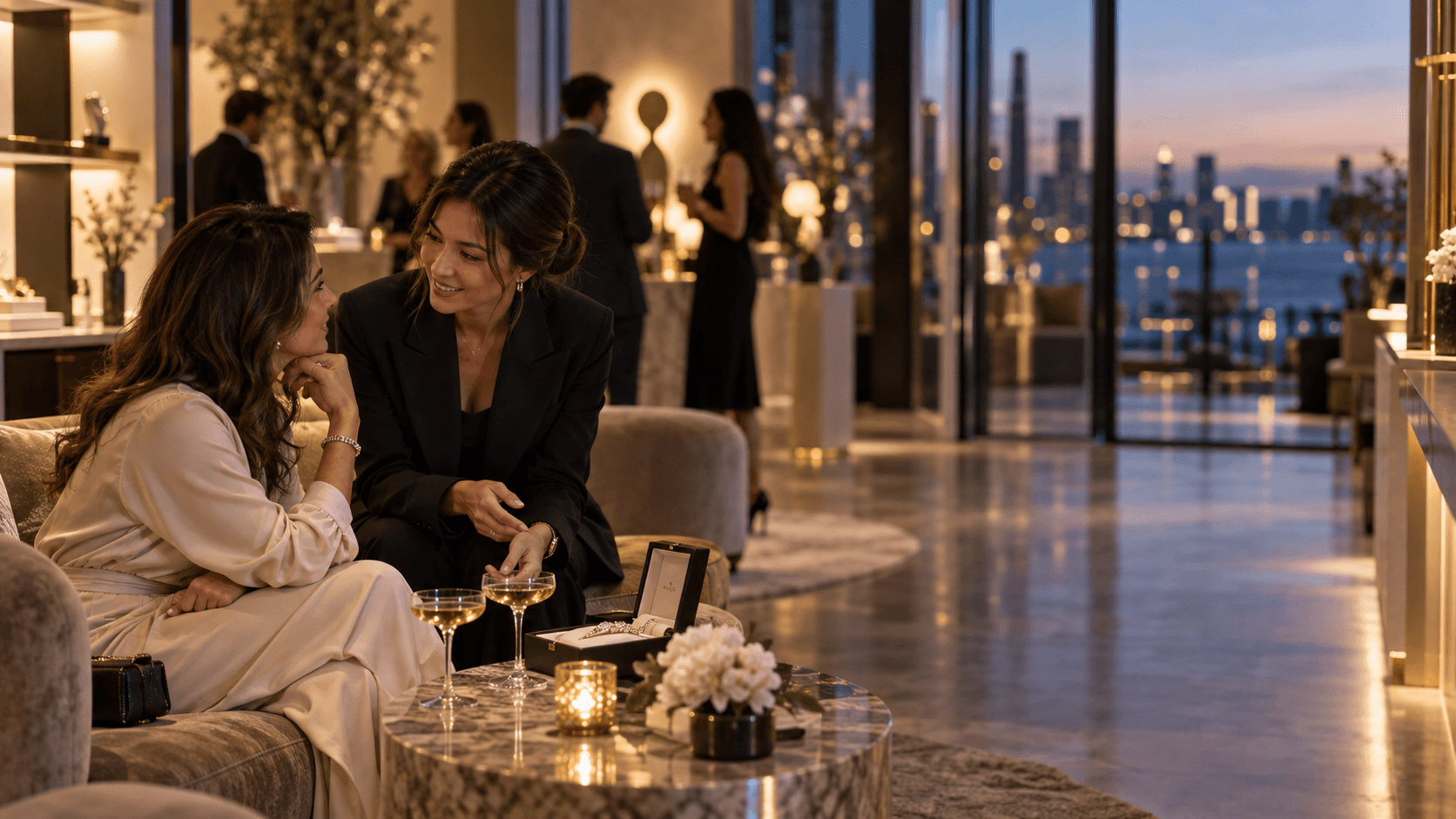
Luxury retail has moved far beyond products on a shelf. Experiential marketing for luxury houses now shapes how people discover, engage with, and stay loyal to the labels they love.
Flagship stores have become stages for multisensory events, invitation only activations, and cultural installations that blur the line between boutique and destination. The brands winning in this climate treat every customer interaction as a data point, and a relationship.
This shift is not cosmetic. Bain and Altagamma report that global luxury spending reached 1,443 billion euros in 2025, with luxury experiences continuing to outpace tangible goods while personal luxury goods settled at 358 billion euros.
The prize behind every activation is an emotional connection with customers that outlives the evening itself. Harvard Business Review research found that fully connected customers are 52% more valuable, on average, than those who are only highly satisfied.
Five Key Takeaways Explain What Drives Luxury Growth Today
Experiences outperform goods. Wealthy shoppers keep moving spend toward experiential indulgence rather than physical products, and that pattern held through 2025 into 2026.
Exclusivity builds a real bond. Invite only events and private activations create the word of mouth and advocacy that paid media cannot replicate.
Physical stores must earn their floor space. Boutiques that blend retail, hospitality, and entertainment into a single experience design see longer dwell time and stronger conversion.
First-party data is the engine behind personalization. Houses that capture interaction data, not just purchase history, deliver outreach that makes customers feel individually known.
AI makes one to one engagement scalable. Technology now lets a luxury company run individual outreach, track engagement across channels, and attribute revenue to specific relationships without adding headcount.
Luxury Stores Are Becoming Experiential Destinations
The flagship store has been reinvented. Where boutiques once focused on display and transaction, leading houses now build spaces that work as lifestyle hubs, part retail, part cultural venue, part social occasion.
Saint Laurent's Rive Droite boutique in Paris houses Sushi Park, an omakase restaurant, inside the fashion space itself. That single detail communicates something no ad campaign can: the brand occupies a place in a customer's whole life, not just their wardrobe.
The Tiffany Blue Box Cafe extends its signature aesthetic into breakfast and afternoon tea. Guests become immersed in the brand identity before touching a single product, and they leave with a memory rather than a receipt.
Bain and Altagamma advise luxury retailers to reimagine physical space around fewer, larger flagships that deliver emotion, immersion, and personalized connection. Store count is no longer the metric. Depth of relationship is.
Experience Design Makes Brands Unforgettable
Experience design in luxury retail means engineering every sensory detail, sound, scent, lighting, pacing, to reinforce brand identity. Stores that do this well report longer visit times and higher average order values.
Interactive mirrors, 3D projection mapping, and AI driven recommendation terminals are no longer novelty features. They are becoming standard infrastructure for any flagship competing for the attention of premium and ultra wealthy shoppers.
Physical space still carries the weight. US Census Bureau data put e-commerce at 16.9% of total retail sales in the first quarter of 2026, which means roughly five of every six retail dollars are still spent in person.
For related context on how a conversation continues after the visit, read What Is Conversational Marketing? on the BSPK blog.
Exclusive Events Build Loyalty Among Wealthy Consumers
Private events remain among the highest impact tools in luxury strategy. Invite only soirees, designer meet and greets, and curated activations give wealthy consumers something no e-commerce channel can offer: access.
Budgets are moving accordingly. Global experiential spending grew 8.3% to 138.94 billion dollars in 2025 and is on pace for 10.3% growth in 2026, according to PQ Media research.
These moments generate organic content, word of mouth referrals, and emotional bonds with the brand. When luxury customers feel like insiders, they return, and they bring others with them.
Activations Turn Guests Into Brand Advocates
Live art installations, mixology sessions, and theme driven exhibitions turn passive shoppers into active participants. The occasion itself becomes the story they share, driving social reach that no paid placement can buy.
The behavioral data supports it. Cvent research reports that 75% of participants felt more connected to a brand after an in person activation, and that companies running these programs generate three times more word of mouth awareness than companies that do not.
Younger affluent audiences drive the demand. Eventbrite's 2026 Social Study found that 79% of 18 to 35 year olds plan to attend more events in 2026, and that they want gatherings which feel unscripted rather than staged.
This topic connects closely with What Is Luxury Customer Experience?, which covers the service standards that keep a first visit from being the last.
Experiential Marketing Strategies Drive Real Purchase Intent
The return on live activation is now documented. Cvent reports that 61% of attendees say they are more inclined to purchase after an event, and that more than 90% of attendees whose trust in a brand increased on site went on to buy.
That conversion lift reflects a relationship rather than a clever execution. It reflects a person who has spent time inside the brand story, met its people, and formed an emotional connection that a display ad cannot replicate.
Speed follows trust. The same data set showed that 72% of attendees convert faster when they attend events, which makes live programs a pipeline tool rather than a pure awareness play.
Customer Experience Is the New Competitive Moat
For wealthy shoppers, the customer experience is the product. A house with impeccable goods but a transactional shopping setting will lose ground to one that wraps its products and services in a curated, memorable ritual.
Expectations are set elsewhere. McKinsey research found that 71% of consumers expect companies to deliver personalized interactions and 76% get frustrated when that does not happen.
Capturing interaction level data, what a client reacted to, asked about, or shared, builds a feedback loop that makes every following visit more personal. That is where live programs and first-party data strategy intersect to create a durable advantage.
As a companion piece, Luxury Retail Strategies explores how those insights get applied across a store network.
Emotional Loyalty Outperforms Transactional Rewards in Luxury Retail
Points and tiers are a transaction. Customer loyalty built on feeling is a relationship, and it behaves differently on every metric a growth leader cares about.
Cvent research found that 40% of customers say live activation directly increases their loyalty to a brand, while 52% of companies name deepening customer loyalty as a primary goal of these programs. Intent and outcome are finally lining up.
The gap shows up in retention. Brands that build emotional connections keep customers through price rises, quiet quarters, and competitive launches, while brands that rent attention with promotions have to keep paying for it.
Harvard Business Review makes the commercial case plainly: an emotional connection matters more than customer satisfaction when you are trying to grow the value of a relationship.
Dimension | Transactional loyalty | Emotional loyalty |
|---|---|---|
What drives it | Discounts, points, tiers | Shared values, recognition, trust |
How customers feel | Fair exchange | A genuine bond with the brand |
What it produces | Repeat purchases | Advocacy, referrals, brand intimacy |
What breaks it | A better offer elsewhere | A broken promise |
What it needs | A rewards engine | Customer insights and memory |
Shared Values Turn Buyers Into Advocates
The five Cs most often cited in experience design map onto this directly. Connection creates emotional resonance, Content creates shareable moments, Community creates belonging, Customization creates personal touchpoints, and Conversion creates measurable purchase outcomes.
Connection and customization carry the most weight at the top of the market. A client who feels seen does not need a discount, and market research consistently shows that emotionally connected buyers are less price sensitive.
Values matter as much as service. When a brand and its customers share a point of view on craft, sustainability, or culture, the relationship survives a price increase that would end a transactional one.
This is why the best houses invest in services around the product: alterations, care, private appointments, and after sales attention. Those services are where trust gets proven, long after the campaign has run its course.
Experiential Campaigns Reach Ultra Wealthy Consumers Through Social and Partnerships
Social media changed how live campaigns spread. When a guest shares a moment from an exclusive event, they provide something an owned channel cannot: a third party endorsement from inside the room.
Cvent reports that 87% of event attendees share what they did on Instagram, making it the leading platform for this kind of content. For houses targeting ultra wealthy consumers, that organic reach carries more credibility than almost any paid channel.
Partnerships with chefs, artists, hoteliers, or cultural institutions let a maison borrow the audience and reputation of related premium categories. These collaborations also create content that reads as editorial rather than promotional, which is the tone high net worth audiences respond to.
Social Media Amplifies Moments That Money Cannot Buy
Designing a moment that someone wants to photograph and share is among the most valuable outcomes here. It extends an exclusive evening to people who were not present, often the right people.
Houses that design around shareability, distinctive visual settings, memorable details, and personal touches generate sustained digital impact from a single activation. The content strategy and the event strategy become the same strategy.
Retail teams may also find Adapting to the Rise of Secondhand Luxury Fashion useful as client values keep shifting.
Luxury Marketing Must Combine Premium Products With Moments Customers Remember
The most effective luxury strategy blends product excellence with experience design. Craftsmanship and heritage remain foundational, but they need a stage to perform on.
The Julius Baer Global Wealth and Lifestyle Report 2026 found that experiences remained the dominant spending category across all regions, led by luxury hotels and premium dining. Experience led segments keep absorbing budget that once went to goods.
Houses that treat the store visit, the event, and the follow up as equal parts of one plan hold on to premium clients. Those that lead with product alone are losing them.
Experiential Retail Creates Moments That Compound Over Time
A single well executed evening generates immediate impact, sales, social content, and emotional engagement. The compounding effect comes from capturing what happened: who attended, what they responded to, what they purchased, and what they said.
When that interaction data sits at the brand level rather than the associate level, it becomes a permanent asset. The next campaign, the next event, the next personal message, all of it gets sharper because the company actually remembers the individual.
For more on how signature moments get built, read The Rise of Quiet Luxury and How Chanel, Louis Vuitton, Dior, and Gucci Create Signature Luxury Store Experiences.
BSPK, the Authentic Commerce Platform Powered by AI and First-Party Data, Turns Interactions Into Lasting Relationships
BSPK is the Authentic Commerce Platform powered by AI and first-party data. It turns everyday customer interactions into AI ready data so your brand can treat every customer as an individual, at scale.
Most luxury retailers invest heavily in live activation and then lose the intelligence those moments generate. The evening ends, the guest list goes into a spreadsheet, and the emotional connection never becomes something the business can act on.
Four structural problems cause that loss. Customer information is fragmented across store, web, and back office systems. AI models get thin, generic signals instead of rich interaction data. Outreach still runs to cohorts instead of individuals. And when frontline staff leave, customer knowledge walks out with them.
In the age of AI, your real advantage is the customer data you own and how intelligently you use it.
BSPK Captures Every High Value Interaction as First-Party Data
Events, appointments, styling sessions, messages, and store visits become structured records attached to a persistent identity. Preferences, wishlists, purchase history, and the small details someone mentions in passing all land in one place instead of a private notebook.
The BSPK mobile app for advisors builds that capture into the normal flow of a conversation, so the record stays complete without extra admin work.
BSPK Unifies Every Signal Into a Single Living Profile
The Single Customer View brings store, e-commerce, inventory, and engagement signals into a single relationship record that marketing, merchandising, and operations can all use. Customer Intelligence turns that record into insights your team can act on the same day.
Real time, two way sync keeps the profile current, and open integrations layer BSPK on top of the systems you already run. No rip and replace, with a two week go live.
BSPK Activates Relationships Across Every Channel Clients Use
BSPK agents do the work nobody has time for. The Acquire Agent scores who is ready to buy, the Engage Agent finds the right moment to reach out and drafts the message in your voice, the Convert Agent briefs the advisor before an appointment, and the Campaign Agent runs personal outreach at scale.
Every message goes out on the channel the client actually uses, including WhatsApp, WeChat, Line, SMS, and email. A person approves every send, so the conversation stays human and the leverage stays with the agent.
Visual storytelling tools let headquarters curate branded collections that advisors personalize for one client, and Analytics and Reporting attributes outreach, appointments, and revenue by store, region, and advisor.
Every Customer Interaction Becomes Permanent Brand Intelligence
Every relationship your team builds trains your brand's intelligence, and each insight makes the next conversation sharper. That is a moat no rival can buy, only earn, because it is assembled from thousands of small moments your team has already lived through. See the results in BSPK case studies and across luxury retail solutions.
Frequently Asked Questions
Experiential Marketing for Luxury Brands Creates Immersive Interactions
Experiential marketing for luxury houses is a strategy that creates immersive, memorable interactions between a brand and its customers, beyond traditional advertising or product display. It includes exclusive events, sensory in store settings, cultural installations, and personalized activations designed to build lasting emotional connections and drive loyalty.
The goal is participation rather than exposure. Someone who participates in an experience remembers the brand differently than a person who scrolled past an ad.
Luxury Retailers Build an Emotional Connection by Making Customers Feel Known
Building emotional attachment starts with knowing the individual: their preferences, their history, their values, and the moments that matter to them. Luxury retailers do this through personal outreach, invitation only access, and service that reflects prior conversations rather than a generic segment.
The practical requirement is memory at the brand level. Capture what happens in every interaction, unify it into one profile, and use it to make the next message land as personal instead of automated.
The 4 Ps of Luxury Marketing Apply With a Distinct Slant
The traditional four Ps, product, price, place, and promotion, apply at the top of the market with a different emphasis. Product stresses craftsmanship and rarity, price signals status and exclusivity, place covers physical destinations and digital touchpoints, and promotion leans on storytelling and earned media over mass advertising.
Emotional marketing sits underneath all four. Each P is a chance to reinforce what the brand stands for and why anyone should care.
Exclusive Events Deliver a Sense of Access Advertising Cannot Buy
Private events produce outcomes paid media cannot: real word of mouth, organic social content, and deep loyalty from people who feel personally recognized. A strong emotional response in the room turns into advocacy outside it.
They also produce first-party interaction data that improves every later outreach, which makes each investment compound rather than expire.
Measuring Experiential ROI Depends on Attribution and Engagement
Measurement has historically been the weakest link in this discipline, and that is changing. Teams now use clienteling platforms to attribute attendance to later purchases, track response rates on personalized follow up messages, and compare conversion among guests who attended against those who did not.
Useful metrics go past attendance numbers. Repeat purchase rate, reply rate, and revenue per attending client show whether an evening produced a relationship or just a good night. The BSPK ROI calculator is a starting point for modeling that impact.
Your Next Step Is a BSPK Demo Using Your Own Data
Every event your house runs is a chance to deepen a relationship or let it fade when the doors close. The difference is whether the intelligence from that evening becomes something your company can use tomorrow.
BSPK makes every interaction permanent, actionable brand intelligence. Less guesswork, more personal outreach, more revenue from the customers you already have.
Book a demo and see your own data in the session. Two week go live, no rip and replace, and a clear view of which customers are ready to buy next.

Similar posts
Emotional Connection With Customers: How Luxury Experiential Marketing Builds Brand Loyalty
By
Paul Andre de Vera
Luxury Retail & Customer Experience

What Sets Luxury Beauty Retail Apart: In-Store Experience, New Formats, and Brand Launch Support
By
Paul Andre de Vera
Luxury Retail & Customer Experience

How Chanel, Louis Vuitton, Dior, and Gucci Create Signature Luxury Store Experiences
By
Paul Andre de Vera
Luxury Retail & Customer Experience

Inside the Luxury Boutique: What to Expect From Appointments, Styling, and the In-Store Experience
By
Paul Andre de Vera
Luxury Retail & Customer Experience
